Meta Brand Rights Protection: When It Works and Why We Were Refused

Meta Brand Rights Protection: When It Works, and Why Meta Refused Us
A friend asked me last month what to do about a competitor running his ad. He had spent five weeks and a real budget on a video, it started working, and three days later a rival was running the same hook with their own footage against the same audience. He wanted a tool. He assumed one existed.
I had spent four months looking for that tool. Here is what I found, including the part where Meta refused our application over a copyright complaint from years ago.
What was happening to us
Our marketing team shipped creatives at volume. Competitors took the winners. We counted four cases a month for months.
The production cost was the smaller loss. Someone who copies your creative skips your research and your testing budget, then bids for the customers you found using the message you paid to discover. We built the asset, then paid more per click to outbid a company running it for free.
The four kinds of tool, and the fifth that does not exist
I want to show you the market before I explain BRP, because the shape of the market is the whole answer.
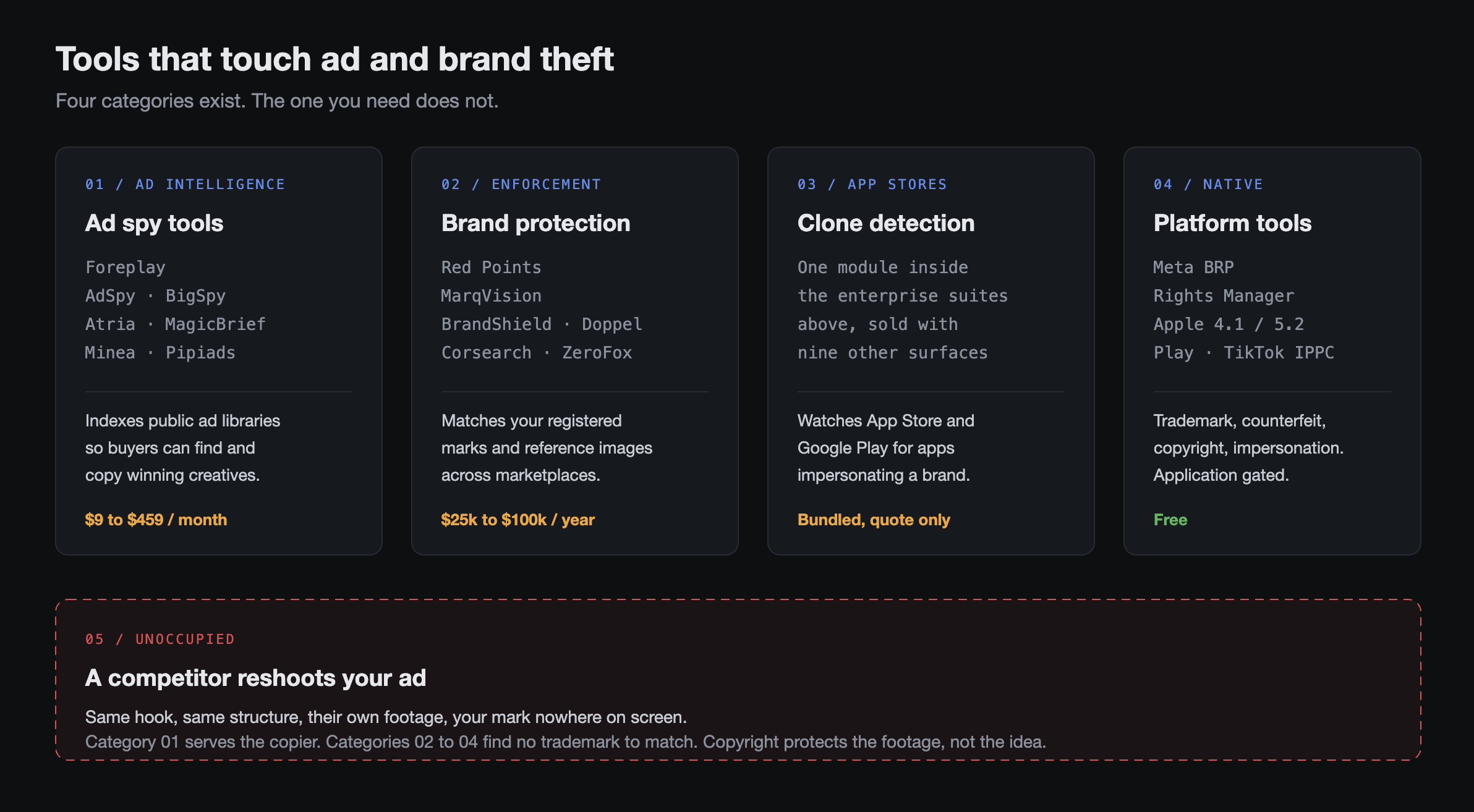
Ad intelligence, also called ad spy. Foreplay, Atria, MagicBrief, AdSpy, BigSpy, PowerAdSpy, Minea, Pipiads. Prices run from around $9 a month at BigSpy's basic tier to Foreplay's agency plan near $459 a month. These tools index public ad libraries so you can find winning ads and build swipe files.
Read that again with your problem in mind. The entire category exists to help people do to you what your competitor did. Foreplay's Spyder tracks brands you choose to follow. Atria scores creatives so you can replicate them. Minea and Dropispy have reverse image search, aimed at finding products to sell. I found no tool in this category that advertises "show me who is running my creative." The market is built for the attacker.
We are building storepatrol.xyz for the defender.
Brand protection platforms. Red Points, MarqVision, BrandShield, Corsearch, Bolster, Doppel, ZeroFox. These are the serious enforcement suites. They scan marketplaces, domains, social accounts and app stores, then file takedowns for you. They match against your registered trademarks and your reference images.
That last sentence is the limit. They catch a stolen logo and a counterfeit listing. A competitor who reshoots your ad shows no logo.
App store clone detection. The enterprise suites above list mobile apps as one surface among ten. I found no affordable self-serve product dedicated to watching the App Store and Google Play for apps impersonating you. This is the gap we are building into, so treat my read as interested.
Platform-native tools, free. Meta Brand Rights Protection, Meta Rights Manager, Meta's IP report forms, Apple's dispute forms, Google Play's impersonation and DMCA routes, TikTok's IP Protection Center. Free, useful, narrow.
The fifth category, a tool that watches paid social and tells you when your creative shows up under someone else's account, has no serious occupant. I will explain why further down, because the reason is technical and it matters.
| Category | Example vendors | What it covers | Catches a reshot copy of your ad? | Price |
|---|---|---|---|---|
| Ad intelligence | Foreplay, AdSpy, BigSpy, Atria, Minea | Public ad libraries, competitor discovery | No, built for the copier | $9 to $459 a month |
| Brand protection | Red Points, MarqVision, BrandShield, Corsearch, Doppel | Marketplaces, domains, social, apps, counterfeits | No, matches marks and images | See below |
| App clone detection | Enterprise suites as one module | App Store and Google Play impersonation | Not applicable | Bundled into enterprise |
| Platform-native | Meta BRP, Rights Manager, Apple, Google Play, TikTok IPPC | Trademark, counterfeit, copyright, impersonation | No | Free |
What brand protection software costs
I asked the vendors who cover our case. We were quoted around $17,000. I assumed I had been sandbagged as a small buyer, so I went looking for public numbers.
MarqVision publishes bands in its own buyer's guide: under $2,000 a month for a focused package, $25,000 to $100,000 a year for growth, seven figures for enterprise. Red Points quotes flat fees on request, and buyer data collected by Vendr, cited by a competitor's blog, puts the average contract near $35,000 a year with some reaching $70,000. One Trustpilot reviewer describes prepaying around €34,000 for twelve months.
So $17,000 was the low end of the real range, and the range starts above what a company our size can sign for one recurring annoyance. Verify these numbers yourself before you quote them at anyone. Two of the three come from a competitor's comparison page, which has an obvious interest in making incumbents look expensive.
The cheapest self-serve option I found in the category, Brand Protector, publishes $199 a month or $1,499 a year across 14 to 16 surfaces. That gap between $199 and $25,000 is where most companies our size sit, unserved.
What Meta Brand Rights Protection actually is
Meta runs BRP inside Business Suite. Once Meta approves you, your team searches Facebook, Instagram, Marketplace and Shops for content misusing your IP, then files takedowns from one dashboard instead of filling out the public form each time. Meta's help center says it handles trademark violations, counterfeit products and copyright infringement in ads, commerce listings, Pages, Instagram accounts and some posts.
Meta reviews a takedown request within about a day by its own account. A 2025 update added scam-ad reporting at scale and reorganised the takedown flow by violation type. The tool costs nothing. Someone on your team needs the IP Reviewer role in Business Settings to see it.
You submit an application and Meta approves or refuses it.
The eligibility condition that got us
Meta lists four conditions on its application page. You need a Business Manager account. You need an active registered trademark, text or image based, registered rather than pending. The applicant works for the brand. And your business must have no history of intellectual property violations.
We had the trademark. Two of our old ad videos used music our team had not licensed properly, and the rights holders filed copyright complaints. We contested nothing, the videos came down, and that was the end of it as far as we knew. Meta refused our application.
Sit with what that condition means as written. Meta gives enforcement tooling to rights holders with clean records and withholds it from a company that once took a strike, including a strike over a background track. If an agency uploaded something careless under your account three years ago, you inherit that.
Now the honest part. Meta does not publish what counts as a "history of intellectual property violations." Nobody at Meta told me in writing that the music complaints were the reason. I am inferring, because we met the other three conditions.
There is no documented appeal path. The documented fallback is Meta's IP Reporting Center and the public report forms, which need no BRP access. You lose the dashboard and the batch workflow. You keep the ability to file. But all of that is to be made by hand. Here at storepatrol.xyz we want to automate this process and help you protect your brand at scale.
Rights Manager is not the backup you think it is
People confuse BRP with Rights Manager, which is the copyright side. You upload reference files, Meta matches uploads against them, and you can set rules that block matches. That sounds like the answer for ad creatives until you read three details.
Rights Manager is not retroactive, so it will not find copies that predate your reference file. Meta requires that you own or exclusively control the rights to what you upload, which rules out the ad you built on licensed stock music, since you do not exclusively control that track. And automatic blocking does not distinguish a thief from an affiliate running approved assets, a reseller, a journalist, or your own agency's second ad account. Meta offers an allowlist. It helps if you can name the accounts that legitimately touch your assets. We could not name ours.
What I told my friend to do
Check whether you qualify for BRP before you plan around it, since you need a registered trademark and a clean record. If you qualify, apply, because it is free and it works well for the cases it covers, meaning counterfeits, stolen logos, impersonation accounts and scam ads using your name.
If Meta refuses you, use the IP report forms. Slower, but the same outcome per report.
For app store clones, go to the platform directly. Apple's App Review Guidelines cover copycats under 4.1 and intellectual property under 5.2, and Apple added language in late 2025 about using another developer's icon or product name. Google Play has an impersonation policy, an IP policy and a DMCA route. TikTok runs an IP Protection Center where you register your IP and file complaints. Every one of these wants the same evidence: exact URLs, screenshots, proof you own the mark or the work, and a clear statement of what was copied. Confirm the current forms and timelines on each platform's live help page, since they move.
We build storepatrol.xyz to help you with those specific problems.
FAQ
Does Meta charge for Brand Rights Protection? No. The cost is the application and the eligibility bar.
Can I apply without a registered trademark? No. Meta requires an active registered trademark, text or image based. A pending application does not qualify. We would not need a registered trademark to do the scan, on the other hand.
Will Brand Rights Protection remove a competitor's ad that copied my creative? Only where the copy carries your trademark, completely or partially copies your creative, or reproduces your actual footage.
What happens if Meta refuses my application to Brand Rights Protection? Meta documents no appeal path. Use the IP Reporting Center and the public IP report forms, which work without BRP access.
Does an old copyright complaint block access? Ours was refused after two old music complaints, and Meta's published condition is no history of intellectual property violations. Meta does not define the phrase, but we presume that even one violation is enough to be rejected.
How long does Meta take to review a takedown request? Meta reviews applications within a day, often faster, once you have access.
We build StorePatrol, which watches the App Store and Google Play for apps impersonating your brand and drafts the complaint text. Read the tool comparison above with that in mind. Waitlist at storepatrol.xyz.
Want to know when someone runs your creative?
At launch, StorePatrol will watch Meta and Google Ads for advertisers using your creative, then draft the complaint for you. Join the waitlist for founder pricing.